On a March 1972 evening in Kyoto, Japan, my two fathers met for the first and only time. The occasion was a tea ceremony, performed in Shokoku-ji, a Zen Buddhist monastery, by Kajitani Roshi, my spiritual father, for my parents Fred and Zelda Seldman.
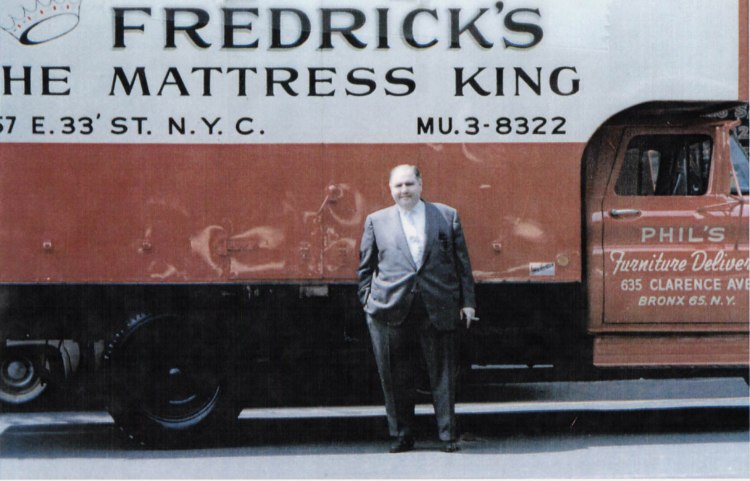
Anyone who knew or even just looked at Fred Seldman and Kajitani Roshi (Roshi is a title for Zen Masters) would be struck by their extreme differences. At that time my dad was over 300 pounds and Roshi-san weighed about 90. Fred was known in New York as “The Mattress King” and selling mattresses perfectly fit his personality. He loved to relax; never rushed anywhere and his other nickname was “Mr. Comfort.” In his whole life he rarely traveled outside his Brooklyn neighborhood, Sheepshead Bay, where he lived for sixty-five years, and his Manhattan neighborhood (Lexington and 33rd St.), where he worked for 45 years. Another thing that distinguished him was laughter. He was famous for telling jokes, and all his friends can remember his belly shaking as he laughed at his own punch lines.
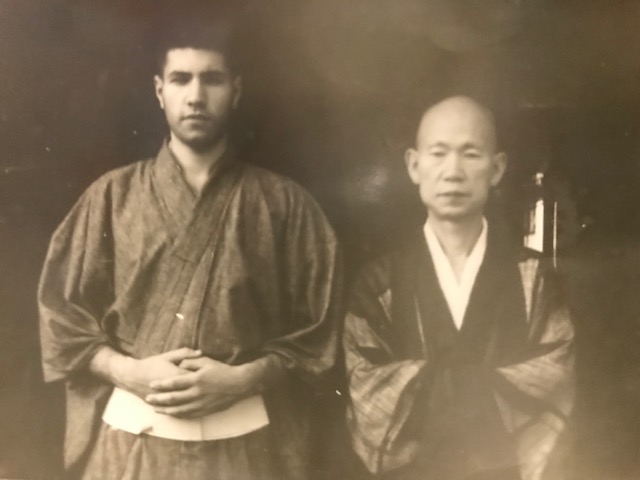
I don’t think Roshi-san had any nicknames, but to think of him as “Mr. Austerity” would be accurate. Even for a Zen Master he was extreme in his simplicity, solitude, and stone-like face. He chose the minimal comforts that could keep him alive and able to perform his role as head of the monastery. The monastery was the only world he knew. Whereas some people chose the monastery and some are sent by their fathers who are priests, Kajitani Roshi was raised there. At nine years old he became an orphan and his relatives asked monks to care for him. Except for 2 years when he lived in the woods by himself to mature as a Zen Master, he had been in a monastery for 50 years.
Before I tell you, what occurred the night that they met, let me explain how we all happened to be in Kyoto.
In the 1960’s the Sealy Mattress Company began using travel as a sales promotion incentive, and Frederick the Mattress King Inc. earned free trips every year. Each year about 100 salesmen and their wives got to see part of the world, and 1972 was their year to see the Orient. I’m not sure my parents would have gone just to see Asia, but by coincidence, I was arriving in Japan from Europe at the same time.
In September 1971 I completed my Ph.D. and 6 years of Army reserves. It didn’t seem like a good time to take on more obligations so I secured a job for the summer of 1972 and took off for 10 months of travel. After living in France, Spain, and Morocco, I headed for Japan for a second round of Zen training. In 1964 after graduating college, I went to Kyoto and through the intervention of Kajitani Roshi, I was allowed to train in the Sodo (monastery) of Shokoku-ji (temple).
I met my folks at the Tokyo airport and joined the group on the train to Kyoto. In Osaka, my dad and I surprised everybody by getting off the train. I had discovered there was a baseball game in Osaka that afternoon, and as I anticipated, he wanted to go.
It was a memorable game in many ways but an incident that occurred on the way to the stadium was the most poignant. In the months since I had seen my dad he had gained weight. Although his weight fluctuated quite a bit he was close to the heaviest I could remember. Seeing the tiny people of Japan seemed to make him more self-conscious and he made a couple of comments as to how skinny everyone was.
Then as we turned the corner about a block from the stadium we encountered a very young, very big Sumo wrestler. He was just about my dad’s size and his face looked remarkably like pictures of my dad during the War. They both stared at each other surprised in a different way. The young Sumo bowed to my father and he responded with a big smile. After that brief meeting his mood brightened. He met someone in Japan he could relate to.
The very next day it was my duty (and destiny) to visit Kajitani Roshi. All Zen students are expected to visit their teacher first upon arriving in a city. Because my travel plans had been uncertain I hadn’t communicated to anyone that I might return to Japan but I went to the Sodo unannounced.
A new monk greeted me and I explained that I once trained there. My Sodo name was Man-san. Fortunately an older monk, Ken-san, was still there and he brought me to the Roshi’s room. It was a strange reunion. Roshi-san seemed glad to see me but reacted with no surprise; rather like he had seen me yesterday although it had actually been 6 years.
We had a nice chat with no glitches until I casually mentioned that my parents were also in Kyoto. Roshi-san immediately offered, and when I politely tried to decline, insisted, that I bring my parents to the Sodo for a special tea that he himself would perform.
I was caught; trapped in a cross-cultural box. Kajitani Roshi was well known for his skill in the Tea Ceremony and for him to perform it just for my parents was an incredible honor. I couldn’t refuse. If I did, I might as well end the relationship. On the other hand the image of my parents in the monastery, in the special, tiny tea ceremony building, interacting with the Roshi, triggered panic. It turned out that my wildest fears of cultural gaps and gaffes were unfortunately exceeded by what actually happened.
The next night after an attempt at accelerated coaching about the Roshi, the Sodo Tea Ceremony, and Japanese culture, my parents and I arrived at the Sodo. While the Roshi got ready, I gave my parents a tour. Although I tried to prepare my mom for what it was like, when she saw how the monks lived she started crying. She felt bad for how difficult their life seemed and what it had been like for me. Fred was quiet.
I took them to the Tea building, a place so special I had never been in it the whole time I was in the Sodo. It seemed especially small and fragile when we entered. My dad gradually lowered himself to sit on the tatami mat but positioned his back to lean against one of the pillars holding up the room.
After a moment’s panic when the collapse of the building flashed before my eyes, the pillar held and I relaxed somewhat, Then the Zen Master entered and I made the introductions.
What I was unable to prepare my parents for was the complete impassivity of the Roshi’s face. After a few moments of stillness as the Roshi prepared the bowls and hot water, my dad said in a loud voice, “Hey Marty, you ever get a smile outta this guy?”
My heart stopped, but then I looked at the Roshi and nothing had changed. I remembered that he didn’t know one word of English. I didn’t respond and the ceremony continued with the Roshi making a bowl of tea and my presenting it to each of my parents and then myself.
I started to get nervous when my folks barely sipped the tea and put their bowls down. Just then the Roshi excused himself to get some special strawberries to serve with the tea. As soon as he left I told my parents to quickly drink the tea. My dad said it was bitter, he didn’t like it, and he wasn’t going to drink it. My mouth dropped in shock. I shot back, “You HAVE to DRINK IT! It would be a devastating insult if you don’t drink the whole bowl. He is famous for his tea!”
My mom said, “I’m not drinking this. It tastes like urine.” I started to beg but I didn’t have time. In an instant I took the risk. I ran across the room and drank my dad’s bowl. Then I scrambled to my mom’s and did the same thing. Any second I expected the Roshi to return and catch me in the middle of the room with no possible way to explain.
I finished my mom’s bowl and crawled to my place just as the Roshi started pushing the bowls of strawberries into the room. As he entered, the room seemed normal. The strawberries had milk and sugar with them and were a big hit with everyone.
The evening ended very well and, despite my nerve-wracking moments, was a qualified success. Of course I didn’t push my luck and I didn’t return to the Sodo until a week later when my parents had left Japan.
My parents and Roshi-san never met again. I stayed and trained at the Sodo for 3 months before starting my career as a psychologist in San Diego. I didn’t see Kajitani Roshi for 17 years but in 1989, while working with Japan Management Institute I visited him again. In 1990 my book was translated into Japanese and I visited him again to give him a copy. Since it included some ideas and practices I learned in the Sodo, he was very happy to receive it. He even asked me to write a dedication in it and sign it. What was most amazing about seeing him again was that he seemed exactly the same and looked just like he did in 1964 although now he was 78.
My dad lived a wonderful life but died just before his 70th birthday in 1989. He was rarely sick but had a heart attack 6 months before he died of heart disease. In his last year he ate so carefully that when he died he weighed less (220) than anytime I could remember.
I was very fortunate to spend a few days with my father in Durham, NC, just before he died. About an hour before my kids and I had to leave for the airport, my mom, dad, and I were talking. My mom was saying how scared she was about my dad’s heart and how afraid she was that he would die.
But Freddy was peaceful. His face was soft and unlined with a slight smile. He said, “Zelda, I’ve had a great life. I’ve lived 70 years, 10 years more than my father did. I’m not worried about dying.”
It wasn’t just what he said. It was his face, his voice, and his smile. I was impressed by what he said but I didn’t think too much about it because I expected him to keep living. But he didn’t. The next day he got worse. My brother flew down and brought him to New York but his heart gave out the next day before I saw him again.
In the time that followed I’ve often thought of what my dad said in the hotel room in Durham. I’m happy that he had such peace. I never knew my dad had such strength and courage. He never talked about God or death. His final words gave me a new way of understanding his whole life.
I guess in one crucial, essential way my two fathers were very similar. Zen tries to teach you to have certain attitudes towards life and death. My dad must have gained his peace and strength someplace else.

 Marty Seldman